IPv6 Subnet Calculator — prefix, range and /64 count
An IPv6 subnet calculator takes a 128-bit address and a prefix length and returns the network’s full and compressed form, its first and last address, and how many /64 or /56 subnets fit inside it — the same network/host split as IPv4, just with far more address bits.
IPv6 subnet calculator
Enter an IPv6 address (abbreviated with :: is fine) and a prefix length.
| Full (expanded) | 2001:0db8:abcd:0000:0000:0000:0000:0000 | |
| Compressed | 2001:db8:abcd:: | |
| Network | 2001:db8:abcd::/48 | |
| First address | 2001:db8:abcd:: | |
| Last address | 2001:db8:abcd:ffff:ffff:ffff:ffff:ffff | |
| /64 subnets inside | 65,536 | |
| /56 subnets inside | 256 |
- 2001:db8:abcd::/64
- 2001:db8:abcd:1::/64
- 2001:db8:abcd:2::/64
- 2001:db8:abcd:3::/64
IPv6 prefix sizes: /32, /48, /56, /64
Who typically gets what size block.
| Prefix | Who typically gets it | Source |
|---|---|---|
| /32 | A common minimum block size regional internet registries assign to an ISP. | RIR allocation practice |
| /48 | The size RFC 3177 originally recommended as a default for an end site; RFC 6177 (2011) later removed the single default, leaving the choice to the network operator. | RFC 6177 (checked 25 Oct 2026) |
| /56 | A size some networks assign to residential customers instead of a full /48, saving address space while still allowing multiple internal subnets. | IETF v6ops draft on end-site assignment (checked 25 Oct 2026) |
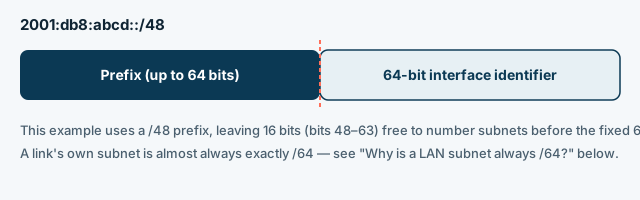
| /64 | The standard size for a single link (LAN subnet) — most unicast IPv6 addresses require a 64-bit interface identifier, which leaves exactly 64 bits for the prefix. | RFC 4291 §2.5.1 (checked 25 Oct 2026) |
Shortening rules (::, leading zeros)
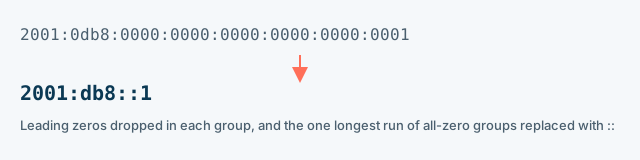
IPv6 addresses are 8 groups of 16 bits, written in hexadecimal and separated by colons. Two shortening rules make them easier to read: leading zeros within a group can be dropped (0db8 becomes db8), and the single longest run of one or more all-zero groups can be replaced once with ::. A :: can only appear once in an address, because the parser otherwise cannot tell how many zero groups it stands for.
Frequently asked questions
Why is a LAN subnet always /64?
Most unicast IPv6 addresses are required to carry a 64-bit interface identifier (RFC 4291), which leaves exactly 64 bits for the network/subnet prefix. Features like SLAAC and privacy addresses are also built around that 64-bit boundary, so giving a link anything other than a /64 can break them.
Do I need to subtract addresses for network/broadcast like IPv4?
No. IPv6 has no broadcast address at all — it uses multicast instead — so there is no “usable hosts minus 2” calculation. Within a /64, essentially every address in the interface-identifier space can be assigned to a host.
What does the :: shorthand mean?
It stands in for one run of consecutive all-zero groups, expanded just enough to make the address 8 groups long. 2001:db8::1 expands to 2001:0db8:0000:0000:0000:0000:0000:0001.
Can I have more than one /64 on the same network?
Yes — a /48 or /56 allocation is simply a block you subdivide into many /64 subnets, one per link (office floor, VLAN, point-to-point interface, and so on), the same way a VLSM plan subdivides an IPv4 block.
This calculator is part of SeaMeWe4 Net Tools, an independent set of free networking calculators. It is not affiliated with, endorsed by or operated for any registry, standards body or network operator.
Was this page helpful?
One tap tells us which guides need more detail.
Thanks for your feedback!